中关村在线

首页 排行 新品 问答 下载 论坛 手机 笔记本 数码相机 主板 显卡 平板电脑 更多

求一篇用英语推销高跟鞋的文章

举报
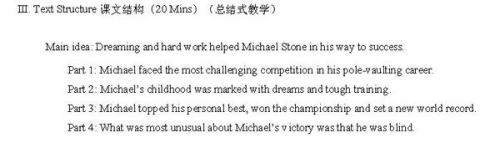
如图,我要做成PPT 最好也可以有中文翻译
讨论回答 (8)
dsffhypkiljd
Suerxi
英语学习的六大原则
我在英语学习方面是十分幸运的。在下过硬工夫的过程中,我从未感到英语学习的单调和苦闷,也未感到英语学习有多么艰难。我读过一些英语名家谈体会的书,其中有中文译本,也有英文原文本。这些书给了我很多启发,使我能够在结合自身学习英语的方法和经验的基础上,总结出符合常识的学习方法,并上升到符合英语学习规律的原则。如果你能按照这些原则一步一个脚印地去做,认认真真地去学习和体味,那么你就定能学好英语。

英语学习应遵循以下六大原则。这些原则都是"常识"性的。正如美国总统林肯所说:一个人必须依据语言、逻辑和"简单的常识"来决定问题和建立自己的行动计划。在学习英语的过程中,你按照常理去做,你就可能成功。你违背了常理,就不可能成功。当然,成功与否还取决于你的"努力"。

这一次,你若按照常理去做,并且下工夫,那你就要成功了!

(一)简单原则

学习英语:从简单的开始
运用英语:简单-好、更简单-更好、最简单-最好

上大学的时侯,英语老师让我们大量阅读英语。有些同学就借来原著,第一页看下来就有20几个生词,第二页还有20几个……到了第五页已不知道第一页所云;到了第十页已不知道前九页讲的是什么。阅读变得异常艰难和单调,体会不到有任何收获,读英语原著变成了查英语词典、记忆生词的过程,变成个苦差事。因此很少有人能坚持下去,就放弃了。其中有人又做了第二次努力,结果还是放弃。原因何在?我想它违背了"循序渐进"的常理。

所谓"循序渐进"就要求你从"简单"开始。学习、使用英语都要遵守简单原则。当年,我碰巧是从英语简易读物开始的。现在,书店里有好多套把原著简写成的"简易读物"。我先读那些用500~800词简写成的读物,后来又读用800~1500词简写成的读物,再后来就读用1500~2500词简写的作品……我能读进去,因为我读懂了;读懂的感觉特别好。当一个人有了成就感时自信心就诞生了,并越来越强,也就产生了更大的兴趣。外国的英语文学作品仿佛带我走进了一个不同的国家,一个不同的文化,一个不同的生活,结识了一些不同的朋友。在走入另样的文化、生活、人物,风俗的过程中就产生了一种强烈的神往,一种强烈的欲望。每时每刻都想读!

只有从简单的开始,才容易入门,才容易产生"兴趣",才容易把事情进行下去。英语阅读应遵守"简单原则",听、说、写都应从最简单的开始,因为简单原则有巨大的优点:

1、造就成就感,培养自信。
2、增加兴趣。
3、语言朗朗上口。
4、易于学以致用。

但是很多中国学生对简单的语言往往不屑一顾,只求理解而不去尝试着使用自己学到的东西。中国学生在学英语中最喜欢追求一个字--"难"。尽管学了很多难的东西,却不会"用"。而事实上,简单的东西如能灵活、准确地使用才是真正重要的。比如从口语来说,人们并不是看一个人会说多么难的单词,关键在于看他能否熟练运用最简单的单词、句型、语法来表达情感、思想。英语国家人们日常生活的交流是通过有限数量的单词和简单的句型来完成的。

Plain English(简洁英语)在英语国家已成为趋势:即在说或写英文时都力求简单。而中国学生尽管学了很多难词,复杂的结构,但就连用简单词和结构来表达思想都做不到;有时用了很大的词,一方面不妥,再者也很难让别人明白。其实当你透彻理解英语中的"小词","简单表达方式"时,才能熟练地用简单英语交际。

当然这并不是说"难的单词"和"复杂句型"一点儿也不能用,或者说没有用,我只是说应该少用或尽量不用。但目前"简单英语"即是"最好英语"的潮流是千真万确的。其实你同外国人面对面交流,你就会惊喜的发现,他们讲的英语是那么的简单,你甚至会反问自己学了多年的复杂英语用处何在?

学会容易的东西,并把容易的东西融会贯通地加以运用才是英语学习的关键所在。

(二)量的原则

多-好,更多-更好,最多-最好

中国人学习英文,精读、精听、精说有余,但泛读、泛听远远不够,大量的乱说就更不够了。没有量的变化,怎么能有质的飞跃?因此,中国人学习英语在注重"精"的同时,必须更加注重"泛"。比如学习英语阅读,如果没有读到足够的数量,就无法熟练地阅读英语。若要学习听力,那就大量地听各种磁带,听英语广播,看英语电视,看英文电影。如要学习英语口语,那就尽量多说英文。学习英语不能太急于求成,因为只有有了"量",才能有"质"的飞跃。

量的积累是必须的。许多人学习英语时,往往有一种误解,认为一本书就代表一个水平。比如,当读完一本初级阅读书时,就会说"我的阅读水平达到初级了",学完一本高级阅读书,便狂欢"我达到高级阅读水平了"。刚刚读了一本初级口语书,就认为已有初级口语水平。读了一本高级口语书,就认为已有高级口语水平。其实,英语学习有一个"点-线-面"的关系。一本书只是一个点,无数本书连成一条线,更多的线形成一个面。所谓"水平"就是面的问题。就拿阅读来说,首先要读大量初级书。当你读完30本初级读物书后,在你读第31本初级读物时已没有几个生词,能轻松地读懂,并进入作者所描绘的世界时,那你就可以读中级水平的读物了。仅仅读过一本初级水平的读物,基础根本没打好,就急于读一个更高水平的读物,那必然就会"欲速则不达",自然不可能学好。也就是说,无论处于何等英语水平,在相应水平上的量的积累是必须的。英语听力、口语、写作的学习亦应遵循这一原则。

语言的学习是培养一种感觉,而感觉要靠数量的积累来培养。俗话说水到渠成。同样的道理,达到了一定的量,"语感"就产生了。这时应再把感觉上升到理念,将理念融入到自己的思维中,英语就能运用自如。请注意量的积累在基础阶段最为重要。金字塔的魅力就在于它完美的建筑结构。有宽广深厚的基础,才能造就塔尖的辉煌。学好英文的道理是同样的。基础必须打牢,也只有在基础打牢的前提下,才能学好英文。

在量的积累阶段,也应该遵循正确的学习方法。以阅读为例,一套简易读物分六级,每一级有五六本,一本只有100页左右,不超过一个星期就可以读完一个级的读物。你在读的过程中,不要太多拘泥于语法,可以偶尔体会一下语法的作用,但主要精力放在理解小说的主题上。要注意,我们是在通过英语获取信息,了解文化、生活,吸收新的思想。你要读进去,才能读得快。不要研究语言,要树立数量第一的观念,尽量快速地读。这样一来,坚持读三四个月,英语的阅读水平就会迅速提高。

总有人问,要花多长时间才能学好英语。这问题不好回答,因为没有衡量学好英文的标准,并且学习英语的速度也因人而异。但有一点是肯定的,那就是你必须有正确的学习英文的方法。实际上,学习英语如按照正确的方法去做,你很快就会入门。从入门到能用英语交际也就是一二年的工夫。因此,如果一直是按照正确的方法做,你很快就能学好英语。

(三)重复原则

英语有句谚语"Repetition is the mother of skills(重复是技能之母)"。你可以回忆一下你学习任何一种技能的过程。无论是游泳还是骑自行车,都是重复同一类动作的过程。 任何技能的获得,当然包括英语这项语言技能,均来自重复。一种事情重复多了,便产生了感觉和深刻的把握。因此,在发展英语技能时,也应该遵循重复原则。比如,在阅读时,当你读过20本初级读物后,就要在这20本中找出一本自己最感兴趣的来读10遍甚至20遍。同样的,当你读过20本中级水平的英语读物后,就应该在这20本中找出一本自己最感兴趣的来读10遍甚至20遍。学习听力和口语也要遵守重复原则。比如说,在听了20盘初级英语听力磁带后,就要在这20盘已听过的磁带中选出一盘,再把这盘磁带听上20遍。在刚开始学习英语口语时,重复原则就更为重要。因为,刚学习英语口语,背诵一些英语后,就找同伴来练,反复重复已学内容。 "重复原则"与"量的原则"缺一不可,要有机地把两者统一起来。学习英语中的任一项技能:阅读、听力、口语、写作,都必须在量的原则的基础上,再反复重复。英语中一定有一些你理解的很透并且已经掌握了的单词或句型,你可以灵活自如地使用它们来交际。请注意,这些熟练掌握了的词和句型一定是你重复过无数遍的,这些被重复的东西已经变成了你的一部分,因此你能把它们运用自如了。重复是人记忆的最重要途径,重复使人准确、深刻理解事物本质、内在规律。 量的原则要求你多读多听,多说多写,强调一个"泛"字。而重复原则要求你将同一件事做很多遍,也就是强调一个"精"字。如此看来两者相互矛盾。但是矛盾是必然存在的。我想世界上最好的东西一定是矛盾的。因为只有两个矛盾体,才能产生最大的动力使主体前进。好的英语学习方法也应力求矛盾的统一。既要有数量的积累,把面铺开,又要同时将一本阅读书、口语书、一盘磁带、一部电影学透彻。在量的基础上把部分内容学"精",这是很重要的。

(四)模仿原则

语言是人们在长时间的实践中形成的认同符号,其运用"规则"可依。孩子学语言是个模仿的过程,他们每天模仿父母、周围的人、电视等一切可以模仿的东西,并且模仿得越来越象,突然有一天,他们停止模仿了,并且逐渐形成融合自己个性特征的语言方式。

作为英语学习者,必须模仿已有的东西,不经历到位的模仿的"创新"意味着错误。创新源于模仿,模仿是学习英语的基础,模仿是创新的基础。只有在你通过模仿,真正掌握了英语的灵魂、精髓,然后,才可能谈到自己的语言风格。

学习英语时,模仿原则是必不可少的。比如在学习语音时,要大量地重复练习音标、单词发音,朗读句子和文章。而在练习过程中,尽量模仿"音标发音和单词发音,同时模仿句子的音调和节奏。模仿对学好语音至关重要。如果你要学习英语口语?模仿亦很重要。在学口语时,要尽量模仿你已经读过的东西和已经听过的东西。当然,如果你模仿你已经用"重复原则"所读过的和所听过的,效果就会更好。如果你要学习英文写作,模仿的重要性更是显而易见。你要读各种不同类型的文章、名家的文章,重复地读过多遍而能真正理解了后,就要一丝不苟地去模仿。模仿得越像越好,这是英语学习最基本的常识。

我的一位朋友英语口语很棒,当他谈到学口语的秘诀时,他总是说"外国人怎么说,我就怎么说;外国人怎么写,我就怎么写。"真可谓一语道破天机!

(五)突击原则

若想学好英语,需要采取一个个"速战速决"策略,找到"快速进入角色"的感觉。只有这样,才能有足够的动力和兴趣把学习坚持到底。你还记得你是如何学会骑自行车、游泳或开车的吗?你是否是通过短时间的"大量突击"练习才掌握这些技能的呢?学习技能的要素是一样的,那就是去无数次的突击训练。当然,学英语或许不像学会骑自行车、游泳那么简单,但驾驭和使用英语语言的确是掌握和培养一种技能。学习一种技能,突击原则是最重要的。

我在学习英语时就运用了这种突击强化的方法。我最初开始学习英语,先突击英语阅读三个月。从简易读物开始,坚持天天最大量地来读。通过突击英语阅读,不但学到了词汇,还熟悉了各种语法现象,更了解了一些西方的生活、文化和思想。紧接着,又去强化听力,经过三个月的听力突击之后,再回过头强化英语阅读。强化完阅读后,再强化听力。强化完听力后,再强化英语口语。按照这个原则,进行阅读-听力-口语-写作的突击强化。按照这种方法来学英语,进步是飞快的。 英语学习从某种意义上说是强化正确意念的过程:强化单词发音的意念,强化单词用法的意念,强化句型的意念,强化组织思想的意念。比如,你若要突破语音,就应该安排一段时间(比如15天)。在这15天内,天天学语音,听语音,模仿语音,学"死去活来"。15天之后,感觉语音有了大的进步,掌握得差不多了就可以停下来。请注意,在模仿的同时,你还应该把自己的语音给录下来,认认真真地找出自己发音的问题,加以纠正。过一段时间后,再按照同样的方法来突击语音。你这样反复突击五到六次,你的语音定将成为最棒的。句型、阅读、语法、听力、口语也都要有这样一种反复突击强化的过程。

一个人的精力不可能总是充沛的,重复做同一件事情就会变得单调,因此就要采取间隔突击强化的方法。英语学习的过程应该是由一个个强化突击阶段所组成的。

(六)兴趣原则

"兴趣是最好的老师",学习英语首先要有兴趣并努力发展这一兴趣。如果你对英语没有兴趣,那就不会有持续的干劲和动力,英语学习将很难坚持下去。反之,一旦你对英语有了兴趣并努力地发展这一兴趣,那么,你就会不知不觉地去做,带着强烈的欲望去读英语,听英语,说英语,写英语。你就会主动地找人去练英语,找一切可以提高你英语的机会去提高你的英语水平。不知不觉中你的英语就会提高。不知不觉中你就把英语学会了。所以"兴趣"对学好英语有举足轻重的作用。 然而,尽管知道兴趣的重要性,但很少有人有意识、有步骤地去培养和发展自己对英语的兴趣。

那么,应如何培养英语学习的兴趣呢?

发现和挖掘兴趣

每个人都有自己的兴趣爱好。把自己的兴趣与英语学习结合起来,是英语学习成功的关键条件。

我对小说很感兴趣,我当年学英语是从大量阅读英文小说Charles Dickens(查尔斯•狄更斯)的简写本读起。19世纪英国人的生活及思想情感在狄更斯的小说里得到了淋漓尽致的展现。进入英语的天地,我畅游在狄更斯的世界里。不知不觉中我学到了许多语言及语言以外的东西:我不仅掌握了大量的词汇、各种各样的语法规则,而且对英国人的生活、文化、习俗也有了深刻的了解。

我入迷了,天天读,从狄更斯到马克•吐温再到海明威,这些小说带我进入一个英语世界,使我在不知不觉中学会了英语。但在阅读时,我根本不想自己正在学习英语,只是努力地读进去。后来,我看了大量的美国电影,电影使我着迷。我在看电影的时候,也不去想自己是不是在学英语。因为我是在兴趣的驱使下做这些事情的,所以做得特别投入,大脑积极地工作,无意识的记忆效果最佳。我同意这种说法:在你没有意识到自己在学习的时候,才是你学习得最多的时候。但请记住,前提是你正从中得到最大乐趣。

我有一个朋友很喜欢股票。他到了美国,每天24小时都有股票电视节目,他就兴致勃勃地去看,但无论如何都看不懂,于是跑来问我。我对中文讲述的股票行情都很困惑,更不必说英语了!于是就对他说我也不懂,但告诉了他如何学会看懂的方法。我说 :"你首先找一份报纸的商业版,然后再借助字典阅读所有的内容,这样你就积累了关于股票的简单语汇。此后,你有空就去看股票的电视节目,这些语汇很快就会从纸上活起来,出现在你的耳边,再加上你有股票方面的知识,很快就能看懂那些节目了。"于是,他真的按照这个方法去做了,因为他对股票的确很有兴趣。等我再去看他时,股票节目他全都看懂了,还边看边给我讲解。另外,通过学习看电视股票的节目,他看别的英语节目时,能听懂的也多了。

一个人如果能够准确界定自己的兴趣、所爱在什么地方--特别是这个兴趣与一个长远的目标相结合,那么他实现自己的目标就很简单了。喜欢电影就看英语的,爱看小说就读英语的,热衷于广播就听英语的……只要通过英语这个媒体做他喜爱的事,他就走向了英语学习的成功之路。

兴趣在"实践"中产生和发展

两个人在一起谈如何学会游泳,谈一会儿就烦了。但是,如果他们能到水里体会一下游泳的感觉,并努力地去学着游,他们就会渐渐爱上这项运动,一旦爱上了这件事,即使不让他去做,他也非要做。我小的时候就很爱游泳,有的时候为了游泳甚至都逃学。

兴趣就是这样在一次次实践中产生和发展的。你对一种事物的热爱在实际运用中产生,并变得越来越深。如果在学英语的过程中,你能够尽早地尝试使用所学的英语的快感,那么你学习英语的兴趣将日益增加。具体地说,就是你一开始学英语就要找机会来用英语。比如说,你刚开始学英语,就去找"老外"聊天,很快就学会口语了。还有,你想提高听力水平,恰巧你喜欢听新闻。那末,如果你坚持每天听英语的新闻,很快就会把听力提高上去。和热爱英语的人在一起"爱"是可以相互传递的。如果一个人对英语充满了热爱与激情,与他在一起的你对英语也自然而然就产生喜爱。我在大学的几个朋友有一个共同的特点:爱英语是没有条件的。别人那种爱英语的疯狂会使你也深深爱上英语。所以你的确应该与喜爱英语的人交朋友,这样,你们对英语的爱就会相互影响、变得更强烈。比如,你有几个喜好学英语的朋友,你们就会组成英语学习小组,一起学习阅读、口语、写作。几个朋友在一起,就用英语聊天,一起讨论英语学习中的体会,相互问问题。如果其中的一个英语水平显著,那么其他人都可以向他的水平看齐。当然,水平高的也可以学习其他人的优点。这样一来,每人的进步都会很快。

树立目标

做事想要成功,就必须树立目标。一旦有了目标,你就会有足够的时间和精力来学好英语。长远的目标应该把学英语同民族的强大、祖国的发展联在一起,同促进世界各国人民之间的交流和理解联在一起。当然,还应该有无数的短期目标。短期目标可以是通过一个英语考试,为了考试而拼命学习英语。短期目标也可以是去世界上任何一个英语国家求学,在出国留学之前,你也要下工夫学习英语。短期目标还可以到世界上各个地方去旅游,找到一份更令人满意的工作。比如成龙,因为会英语,他不仅可以在中国拍电影,还可以到英语世界去拍,呈现在他眼前的是一个更加缤纷的世界。因此,一个人如果能够通过一个具体的想象,看到自己学好英语之后的灿烂的未来,即使他学习英语有挫折,也会坚持不懈地学下去,直到学好为止。

投资增加兴趣

我对美术作品很感兴趣,我买的艺术品越多,我对它们的爱就越深,因为这样我才有机会真正深入到我喜爱的东西中去:"陷得越深,爱得越深"。如果你喜欢听英文歌曲,那就去买磁带、CD,你的兴趣会随着欣赏不同的音乐而增长。如果你喜欢英语,你就要买各种各样的英文书籍,各种各样的英语磁带,各种各样的英语报纸杂志,你还要参加不同的培训班,这些投资会使你找到英语的趣味性,并使你发现英语给你带来的奇妙世界。当你体味到英语内在的趣味之后,进入英语语言所带来的信息世界,你的英语学习的兴趣自然会提高。

综上五条,英语学习的关键是找到突破口。你喜欢阅读,那不妨从简易读物开始,你喜欢歌曲,不妨就从英语歌曲听起,你喜欢报纸,就从报纸读起,你喜欢电影,就先看英语电影。记住,做任何事情兴趣是最重要的!
635712741
wqeqweqweqweqweq
How particle smasher and telescopes relate

By Elizabeth Landau, CNNupdated 7:54 AM EST, Sun February 17, 2013

(CNN) -- A $10 billion machine that smashes particles together is shutting down this weekend, taking a staycation in its 17-mile tunnel near the French-Swiss border while receiving maintenance and upgrades. The Large Hadron Collider, one of the world's largest science experiments, will resume operations in 2014 or 2015 at unprecedented energies.

Do you care?

Judging from the many comments that we get at CNN.com about what people perceive as a "waste" of money for scientific exploration, you might not. That may be because what happens at the LHC seems far removed from everyday life, and even farther from the study of stars.

"Everybody is, in some sense, an amateur astronomer. We all look up at the stars and wonder how the universe works," says Joel Primack, professor of physics and astrophysics at the University of California, Santa Cruz. "People are not amateur particle physicists."

Our window into outer space is visible and dazzling. We can see spaceships and telescopes launch into the sky, and we can see the images they send back.

Inner space, the fundamental building-blocks of everything on a ridiculously small scale, isn't visible. A lot of our understanding is based on theory and probability. Even the greatest achievement at the LHC isn't certain; we can only say that a particle was found resembling a theorized entity called the Higgs boson.

But exploring the very small and the very big and distant are both important for understanding the world in which we live, scientists say, and are necessary for completing the same puzzle.

"The basic story is really that understanding particles and interactions helps us understand the evolution and structure of the whole universe, and hopefully will give us technologies that will allow us to explore it more efficiently and solve energy problems and so forth," said Joe Incandela, spokesperson for the LHC's Compact Muon Solenoid experiment, a large particle detector.

What the universe is made of

Over the last few decades, scientists have come to the conclusion that the universe's composition is only about 5% atoms -- in other words, the stuff that we see and know around us. That means the rest is stuff we can't see. About 71% is something called "dark energy," and another 24% is "dark matter."
2011: Closing in on the 'God particle'
Why is the 'God particle' a big deal?
2010: World's biggest science experiment
Festival aims to make science 'cool'

Research is ongoing to figure out precisely what these "dark" components are, because they do not interact with ordinary matter and have never been directly detected.

But the large-scale structure of the universe depends on dark matter. "Without the dark matter, all the stars would fly away," said Adam Riess, physicist at Johns Hopkins University and the Space Telescope Science Institute.

Dark energy is thought to be responsible for the accelerating expansion of the universe, and Riess's Nobel-prize winning work supports this theory.

In principle, these phenomena are everywhere -- but how can we find them?

What particle physicists are really looking for

All that space in between star clusters is not empty at all. Particle physicists are hoping to get a better understanding of space time, the fabric of the universe.

There are particles hiding behind this fabric that we don't normally see, but with enough energy you can draw them into existence, Incandela said. Scientists expect several as-yet-unseen particles to be there because they help fill gaps in the Standard Model of particle physics. The LHC uses high-energy particle collisions to try to find them.

Incandela likens this to being in a boat with fish underneath, which are nibbling at the surface. It takes a lot of energy to pull one out. The Higgs boson, being so hard to pin down, would be like a whale, Incandela said.

One pitfall of this analogy is that you can easily identify real fish, but it's a lot harder to classify particles that slip in and out of existence in less than a second.

The particle that has made headlines recently is the Higgs boson, aka "God particle" -- a term a lot of scientists hate. Nobel Prize-winning physicist Leon Lederman wrote a book with "God Particle" in the title, but reportedly said he'd actually wanted to call it the "Goddamn Particle."

This particle is a component of something called the Higgs field. Brian Greene, theoretical physicist at Columbia University and "NOVA" host, describes it this way:

"You can think of it as a kind of molasses-like bath that's invisible, but yet we're all immersed within it," he said. "And as particles like electrons try to move through the molasses-like bath, they experience a resistance. And that resistance is what we, in our big everyday world, think of as the mass of the electron."

Without this "substance," made up of Higgs particles, the electron would have no mass, and we would not be here at all. It's not a perfect metaphor, though; we don't feel particularly sticky.

The collision energy at the LHC went up to 8 TeV (trillion electron volts) in 2012, a record for the amount of energy in particle collisions. After downtime of about two years, it will come back online with 13 TeV.
"It really feels like we're on the verge of a breakthrough."
Joel Primack, physicist at UCSC

With higher energies, it may be possible to detect the signature of dark matter, learn more precise properties of the particle that looks like the Higgs, find evidence of extra dimensions and perhaps find out whether gravity itself has a particle.

"If you want to understand the big, you have to understand the small," Primack said.

Dark matter and energy

Primack proposed an idea for dark matter in 1982 that is still a leading contender: The notion that supersymmetry is responsible for dark matter.

That means that for every particle we know, even the Higgs, there is a partner particle with similar interactions but that is more massive. All these partner particles are unstable except for the lightest one, which can't decay into anything else. Dark matter would be this lightest particle, called a weakly interacting massive particle, or WIMP.

There are several underground experiments worldwide that are aiming to detect these dark matter "WIMPs," such as the LUX Dark Matter experiment in the Black Hills of South Dakota, where liquid xenon is stored a mile underground.

Similar experiments include the Xenon 100 experiment at the Gran Sasso Mountain in central Italy. Scientists will go even deeper at the PandaX experiment at the China Jin-Ping Underground Laboratory, located under 1.5 miles of rock.

The principle behind these experiments is that particles hitting the xenon cause the nucleus of the atom to give off a little bit of light. By examining the resulting charge and light produced in this collision, scientists can determine whether dark matter was involved. At least, in theory -- so far, no dark matter has been detected that way.

These experiments are happening at the same time that the LHC is colliding particles, and may find evidence of dark matter that way.

"It really feels like we're on the verge of a breakthrough," Primack said.

Meanwhile, in space, scientists are looking for the signatures of dark matter and dark energy. Riess and colleagues used the Hubble Space Telescope to measure supernovae that are very far away, showing that dark energy must be responsible for how the universe appears to expand faster and faster. This won them the Nobel Prize in 2011.

The James Webb Telescope, costing about $8 billion, will succeed Hubble. The planned telescope will have a 21-foot diameter mirror, six times as big as Hubble's. Among other things, this telescope is also looking for evidence of dark matter and dark energy.

"There's a huge synergy there, in astronomers trying to find the influence of dark matter by mapping stars and galaxies and large structures in the universe, and particle physicists trying to discover the source of that influence of dark matter through subatomic particles here on Earth," said Jason Kalirai, deputy project scientist for the telescope at the Space Telescope Science Institute.

What technology may come

The question remains: What is this all good for?

There's the pure satisfaction of having greater knowledge of the universe in which we live.

"It's just one of the things that distinguishes humanity, that we can actually answer questions that are deep and fundamental, make predictions and do science, and that it actually works," said Lisa Randall, professor of physics at Harvard and author of "Knocking on Heaven's Door."

Consider also that all the technology you know can be traced to pure research, initially perceived as esoteric. Electric lights -- and, indeed all of electricity -- came from fundamental research in the 19th century.

Computers and transistors arose from the understanding of quantum mechanics in the 1920s and 1930s, Incandela said.

Certainly, Einstein didn't know that his relativity theories would become pertinent to your smartphone's GPS. The atomic clocks on satellites must be corrected because, in accordance to Einstein's predictions, moving objects in space are on a different "time" relative to an observer on Earth.

"Technology usually lags pure science by a large amount of time, and I would say, probably now there's a good chance we're further ahead of technology than ever before," Incandela said.

Even the World Wide Web arose out of a proposal from Sir Timothy Berners-Lee, who was a physicist at CERN in the 1980s. Essentially, the reason we have the Internet that we all know and love is that Berners-Lee wanted to enable better communication among physicists there.

It's likely, Primack said, that useful things will also come from the searches for dark matter and dark energy, and for other particles that the LHC is hunting. No one knows what the uses will be yet -- but then again, no one predicted that the World Wide Web would arise at a particle physics lab, either. CERN is, in fact, the same laboratory that houses the LHC.

Nothing is certain, of course, it is at least possible that doing this pure science could help bring into reality the sorts of technologies that right now seem like science fiction.

"If we're really going to explore the universe, in terms of actually moving through the universe and having the ability to do space exploration that's what you see in the movies, so to speak, the 'Star Trek' type things, in principle, we're going to need to understand and have the ability to harness the potential of nature at a level that we don't have now," Incandela said.
bbb3634163
It is no coincidence that the first reported sightings of unidentified flying objects came after the revelations of the secret military projects of World War II. America has always been a land of invention, from the cotton gin to the telephone, from the airplane to the Motel (1925). But wartime inventions raised the status of our technology from awe-inspiring to mythic. Working in total secrecy while spending billions of dollars building whole cities and manufacturing plants, the Manhattan Project succeeded in extracting the energy of the atom and building a doomsday weapon. What could not be accomplished by the American military working in secret? What else was being accomplished?

This was the background for sightings of peculiar objects in the skies, beginning 间量失属信吗in June 1947, in the Southwestern desert area which had so many secret military installations. The objects could be some new super-secret aircraft developed by the U.S. military. Or could they have 答动九史图侵了作缺been developed by some other technologically advanced beings, perhaps from beyond the Earth or the solar system? After all, we now knew that the technology to permit space travel was possible. And these elusive objects traveled far faster and maneuvered far more adroitly than even a jet airplane.

There were many skeptics, however, who considered the objects pie in the sky--or more exactly "flying saucers" (1947), since excited observers had described the objects as saucer-shaped. The name flying saucers caught on, making serious research difficult. As a 1953 book Flying Saucers Have Landed complained, "ever since the cliché 'flying saucer' was coined, the greatest and most exciting mystery of our age has been automatically reduced to the level of a music hall joke."

The believers preferred the solemn government designation unidentified flying object, first used in 1950. But that was a little weighty for everyday use, so in 1953 the acronym UFO was coined to replace it. It has dignified the pursuit of the elusive objects ever since. Those who study them have been known at least since 1959 as ufologists, and their field of study has been ufology. But most people still couldn't find the alien spaceship in the tail of the Hale-Bopp comet of 1997, and the saucers--oops, UFOs--still haven't landed on the White House lawn.
f724717
xiaokongkong2011
060525
你要啥内容的?
展开查看全部 8 条讨论
扩展阅读

罗技瑞士总部直击|GPW5首发的HITS电磁微动系统到底有多强?

评论 7

罗技瑞士总部直击|GPW5首发的HITS电磁微动系统到底有多强?

新一轮旗舰大战将至:小米去背屏,OPPO死磕小屏影像

评论 7

新一轮旗舰大战将至:小米去背屏,OPPO死磕小屏影像

《仁王3》系列革新之作:瀚铠RX 9070 XT显卡4K满帧

评论 8

《仁王3》系列革新之作:瀚铠RX 9070 XT显卡4K满帧

手机里加个散热风扇,真能利大于弊?

评论 9

手机里加个散热风扇,真能利大于弊?

同样内置风扇,直吹SoC和主动散热风道有何不同?

评论 7

同样内置风扇,直吹SoC和主动散热风道有何不同?
热门问题

平凡的荣耀父亲给女儿出气是第几集啊

1838 浏览 4 回答

平凡的荣耀父亲给女儿出气是第几集啊

电子发票代码在哪里看

5983 浏览 6 回答

电子发票代码在哪里看

免费韩国漫画在线观看的地址有么?

8068 浏览 5 回答

免费韩国漫画在线观看的地址有么?

3dmax模型导入真实拍摄的视频

6294 浏览 8 回答

3dmax模型导入真实拍摄的视频

拼多多的客户服务电话是多少啊?

3213 浏览 6 回答

拼多多的客户服务电话是多少啊?

oppo手机型号p开头是什么意思

8599 浏览 5 回答

oppo手机型号p开头是什么意思

华为手机有几个档次 最好 中等 下等 分别是好不好的 怎么一看就清楚的

9721 浏览 4 回答

华为手机有几个档次 最好 中等 下等 分别是好不好的 怎么一看就清楚的

懂行的人建议买vivo还是OPPO手机?!

716 浏览 7 回答

懂行的人建议买vivo还是OPPO手机?!

我用YY进入许多YY上的影院想看电影 ,为什么进去就公告上是黑屏看不了?

8298 浏览 5 回答

我用YY进入许多YY上的影院想看电影 ,为什么进去就公告上是黑屏看不了?

中国体育彩票怎么样兑奖

8174 浏览 6 回答

中国体育彩票怎么样兑奖
最新问答

世界第一人与社会生活

2567 浏览 3 回答

世界第一人与社会生活

迪士尼盈利之谜

693 浏览 8 回答

迪士尼盈利之谜

里夫斯崛起,湖人新星绽放

1767 浏览 7 回答

里夫斯崛起,湖人新星绽放

绝地求生职业赛事禁龙争议

5026 浏览 5 回答

绝地求生职业赛事禁龙争议

杜兰特加入勇士前,勇士能否击败骑士?

8177 浏览 7 回答

杜兰特加入勇士前,勇士能否击败骑士?
举报
举报成功

经过核实后将会做出处理,感谢您为社区和谐做出贡献。

请选择删除原因
删除成功
确定推荐该回答?
推荐成功

更多频道

频道导航
辅助工具